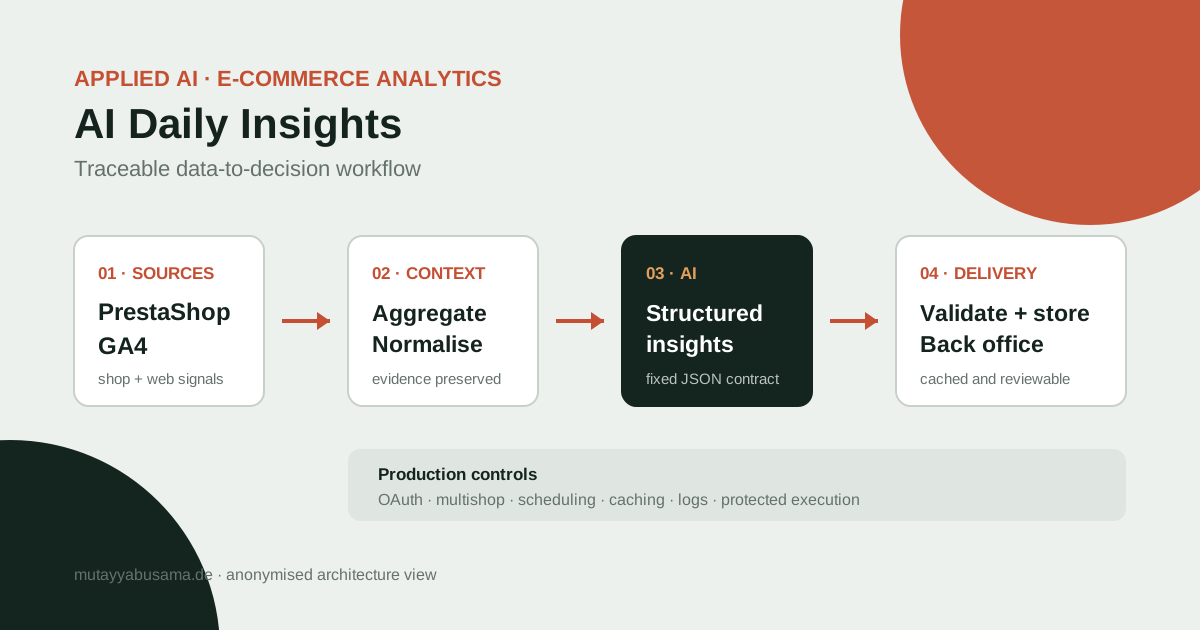
For Ballonswelt, I developed an AI-powered PrestaShop module that regularly combines operational shop metrics with web analytics data. Instead of creating another reporting dashboard, the workflow turns the data into a compact set of prioritised observations and recommendations.
Problem
Shop and analytics systems provide many individual metrics. The daily challenge is not retrieving those numbers but interpreting them together: what changed, which observation matters, and which action should be reviewed?
The system was therefore designed to organise existing data as traceable decision support rather than replace it. Every generated recommendation needs a clear relationship to the underlying measurements.
Solution
A multi-stage workflow aggregates data from PrestaShop and the GA4 Data/Admin API, builds a controlled analysis context, and sends it to a configurable language model through the OpenAI Responses API. The structured JSON response is validated, persisted, and displayed directly in the back office.
| Stage | Processing | Result |
|---|---|---|
| Collection | Retrieve shop metrics and web analytics signals | Shared data foundation |
| Aggregation | Condense time ranges, products, channels, and conversion signals | Compact analysis context |
| AI analysis | Interpret patterns, anomalies, and potential actions | Structured insights |
| Validation | Check required fields, categories, and evidence | Processable result |
| Delivery | Persist, cache, and render results in the back office | Fast daily dashboard |
Analysed data
The shop perspective includes orders, revenue, average order value, product performance, catalogue status, stock, and abandoned carts. GA4 adds users, sessions, engagement, conversions, channels, devices, landing pages, and product data.
Sources remain distinguishable. Observations are derived from the supplied context and stored together with their evidence.
Structured AI insights
Each insight follows a fixed schema containing a summary, priority, category, confidence indicator, observation, recommendation, and evidence. This format supports validation, presentation, and later processing.
The confidence indicator is treated as guidance rather than a statistically calibrated probability. Measurements and evidence remain the dependable basis for decisions.
Production engineering
- Daily results are stored and cached by shop, language, and date.
- The back office loads existing results without invoking a model on every page request.
- Raw metrics, structured insights, input state, and creation time remain traceable.
- Generation and error logs support operation and diagnosis.
- Execution is available manually, through a protected cron endpoint, and through Symfony Console.
- Multiple languages and multishop structures are part of the data and execution model.
- Analytics access uses Google OAuth 2.0 with property selection; a service-account fallback supports alternative technical configurations.
Reliability and security
Generation runs outside the regular dashboard request. Protected automation endpoints, controlled credentials, persisted results, and error logs reduce operational risk. The model and output language remain configurable without tying domain logic to one model version.
Guiding principle
AI should not generate more numbers. It should turn existing data into reviewable attention: what matters, why it matters, and which next action deserves consideration?
Outcome
The module connects e-commerce data, analytics, and generative AI in a repeatable decision workflow. Relevant developments become visible inside the existing back office while data collection, model processing, and the user interface remain technically separated.
What this case study demonstrates
- Production LLM integration in an existing e-commerce system
- AI-powered analytics and decision-support workflows
- Structured outputs, validation, and evidence traceability
- Data aggregation across multiple operational sources
- Caching, persistence, logging, and controlled automation
- Multilingual and multishop-aware system architecture
More about AI engineering
Other pages cover my work across intelligent workflows, full-stack applications, TYPO3, PrestaShop, APIs, and production delivery.
AI engineeringProject overviewPrestaShop profile